
Sarah’s Skin Tag Removal
A Patient’s Firsthand Experience at Specialist Skin Centre in Liverpool
Did You Know?
Skin tags are extremely common, affecting nearly half of adults, and they become even more frequent with age. These non-cancerous growths usually appear in skinfolds, such as in the neck or eyelids, often causing no trouble at first until they produce discomfort or become a cosmetic concern.
Treatment options are usually quick, but knowing who to see for skin tag removal in Liverpool or Chester isn’t always easy. In this article, we share the experience of Sarah Taylor, who visited Dr Thiru at Specialist Skin Centre for a safe and effective solution to this problem.

Sarah, skin tag removal patient at Specialist Skin Centre
Meet The Patient
Sarah, a global events director, was 48 years old when she first consulted Dr Thiru for small skin lumps in her armpits.
“I noticed them 2 years earlier, but they weren’t painful, discoloured, or itchy, so I didn’t think much of them,” she shares. “Over time, and with work keeping me busy, the lumps gradually grew to 3 or 4 millimetres.”
Sarah continues, “Around 6 months before my first visit to Dr Thiru’s Chester clinic, the skin tags started rubbing on my clothes and causing discomfort. They also became more conspicuous in the summer when I wore lighter outfits. That’s when I decided it was time to have them removed.”
Sarah has had recurring skin tags since her early 20s, each one removed by a consultant dermatologist using a scalpel in a simple excision procedure. She has psoriasis that’s currently under control. She has no other long-term health problems, such as hypertension or diabetes, and no one else in her family has the same skin conditions. Below, we probe further into her skin tag treatment journey.
Q: How Did You Decide Where to Go for Your Skin Tag Removal Procedure?
Sarah recalls, “I first thought about going to the dermatologist who treated my psoriasis, but he was fully booked, and I would have had to wait a month. I wanted the procedure sooner so I could deal with the problem right away.
“I searched online for a dermatologist with good reviews and came across Dr Thiru, who was in the same practice as my previous doctor. I checked his credentials, and knowing that he had expertise in oncology and aesthetic dermatology reassured me that he was more than qualified to treat my skin problem. Luckily, he was available right away.”
Knowing that Dr Thiru had expertise in oncology and aesthetic dermatology reassured me that he was more than qualified to treat my skin problem.
Q: How Did You Decide Where to Go for Your Skin Tag Removal Procedure?
“I was in the waiting room with my mother at the time,” Sarah recalls. “Instead of having a member of his staff call us in, Dr Thiru came out himself to greet us, then he invited us into his examination room for a proper assessment. I appreciated that—his coming out personally—because it added a very human, personal touch.”
Q: What was it like talking about your skin concern?
“Dr Thiru asked the usual questions about my general health, the skin issue I came in for, and any past and current skin conditions.” Sarah emphasises, “I talked him through everything, and not once did I feel rushed. I immediately felt at ease and comfortable opening up to him. I didn’t feel embarrassed at all.”
Q: What do you think of Dr Thiru’s approach to the skin exam?
“He examined the skin tags with his dermatoscope. I felt the examination was professional and respectful,” Sarah answers.
Q: How did you find his explanation of this skin growth and the treatment plan?
“I already knew a bit about skin tags before consulting Dr Thiru,” the patient shares, “but he recommended a different skin treatment—electrocautery—which, he said, would cauterize and effectively get rid of the lesions, seal the areas, and prevent bleeding, scarring, and infection. His explanation of the procedure was thorough and easy to understand, and I found it really impressive.”
Q: How Did the Skin Tag Removal Session Go?
Sarah recalls, “After my consultation, I didn’t have to wait very long—about a week—for my procedure. The treatment had to be carried out at Dr Thiru’s Liverpool clinic.”
“During the procedure, he cleaned the affected areas, used some local anaesthetic to minimise discomfort, and removed the skin tags. The whole process was very quick. I went home right away and had no problems afterwards,” she continues.
I talked Dr Thiru through everything, and not once did I feel rushed. I immediately felt at ease and comfortable opening up to him. I didn’t feel embarrassed at all.
Q: What Was the Healing Process Like?
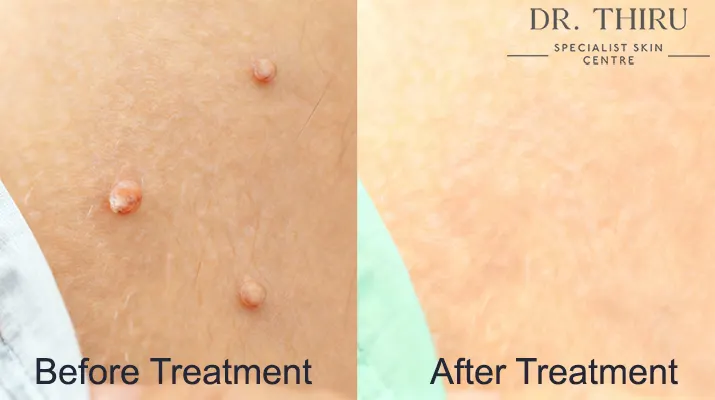
“The treated areas healed really well. There was no itching, discomfort, or sign of infection,” Sarah confirms. “One of them had a tiny scab, but it disappeared after a few days.
“Also, the cauterised areas look completely normal now—you wouldn’t even know I had a skin tag removal treatment there. Dr Thiru’s cutting-edge treatment left me with no scars—not even minimal scarring—unlike previous operations with a scalpel.”
Q: Did You Have Any Follow-Up After the Procedure?
Sarah shares, “For this skin tag issue, I sent Dr Thiru an email to let him know everything was fine. I didn’t have a scheduled follow-up specifically for this procedure, but I did go to him later to have a mole check. I have a few moles of different sizes on my back, and I thought it was important to have them looked at, probably every 6 months, to make sure nothing serious was developing.”
“I was extremely impressed with Dr Thiru. I will be continuing my care with him as my consultant dermatologist,” Sarah asserts.
Q: Would You Recommend Dr Thiru to Your Family and Friends?
“Absolutely!” Sarah declares. “As I mentioned earlier, my mother was with me during my first consultation, and she was just as impressed with the doctor as I was. I later took her to see him for a rash. Dr Thiru didn’t just focus on the skin—he also asked about her other medical conditions.”
“Then, he noticed her coughing,” Sarah continues. “He asked a few more questions to understand the whole clinical picture. He was very observant! He then explained that my mother’s rash was actually her body’s reaction to a viral illness, which made perfect sense.
“So Dr Thiru is not just a ‘skin doctor.’ It’s reassuring to see that he uses his full medical expertise when assessing patients.”
Q: What Stands Out to You About Dr Thiru’s Service?
“I appreciate how, every time we see him, he goes above and beyond what most consultants do. Many consultants sit behind a table with the patient across from them, almost like a teacher or headmaster addressing a student. It feels cold and clinical,” Sarah elaborates.
“Dr Thiru does the opposite. He sits with us on the same side of the table and talks to us like we’re genuinely part of the conversation.”
Q: How Would You Describe the Staff at Specialist Skin Centre?
“The staff are friendly and helpful,” the patient notes. “They made booking my appointment really easy, and they even sent an email to confirm everything.”
Q: Is There Any Advice You’d Like to Share with Other Patients?
“I found out through this whole process that the NHS no longer funds skin tag removal, which they did years back. For anyone with the same skin condition, my advice is to skip the GP appointment and go straight to a private consultant dermatologist. That should help them save time,” Sarah relates.
“Additionally, GPs may not treat the problem as proficiently as dermatologists who specialise in skin tag removal, which is a form of skin surgery. In my experience, I’ve also encountered a few GPs who have diagnosed skin conditions incorrectly. So for peace of mind, I would suggest patients go and book with a consultant dermatologist straight away. And if they’re in Chester or Liverpool, they should definitely look for Dr Thiru.”
Balancing Science with Compassionate Care—The Specialist Skin Centre Promise
Indeed, there are various ways to manage skin tags. Besides surgical excision and electrocautery, other skin treatments appropriate for this condition include laser resurfacing, which burns the lesions with powerful light energy; cryotherapy, which freezes skin tags; and radiofrequency, which uses targeted electrical currents to remove them.
Any of these techniques can benefit patients. However, factors such as cosmetic outcome—especially in facial areas—cost-effectiveness, and scarring risk help determine which approach is most suitable. Remember, every patient is different.
I was extremely impressed with Dr Thiru. I will be continuing my care with him as my consultant dermatologist.
Our Clinic Has Everyone Talking—See for Yourself Why
Dr Thiru is a private dermatologist with extensive experience in medical, surgical, and cosmetic dermatology, serving patients in Liverpool and Chester for decades. He has helped countless patients boost their confidence by treating diverse skin lesion types, from skin tags and acne scars to wrinkles and even skin cancer.
Don’t wait to achieve better skin. Book your consultation today!
REFERENCES:
- Pandey, A. & Sonthalia, S. (2023). Skin Tags. StatPearls Publishing. https://www.ncbi.nlm.nih.gov/books/NBK547724/
- Syed, S. Y. B., Lipoff, J. B., & Chatterjee, K. (2023). Acrochordion. StatPearls Publishing. https://www.ncbi.nlm.nih.gov/books/NBK448169/